
James Hardie ADU Design & Permitting: The Westchester Owner’s Guide
James Hardie siding and trim systems for ADU projects in Westchester typically run $18,000-$34,000 installed for a 500-square-foot unit, including the complete permit set, material specification, and coordination with your build sequence. We stock HardiePanel vertical siding, HardiePlank lap siding, and the full HZ10 coastal-grade trim catalog for same-day specification on active projects. Most Westchester owners discover their James Hardie specification needs revision when the city returns plan check comments citing fire-resistant assembly requirements for L.A. County Zone 1, or when their contractor realizes the original spec called for HardieBacker in a wet-location application that demands HardieZone 10 formulation instead.
The permit set comes first. Everything else is a conversation about sequence.
Which James Hardie Models This Applies To
James Hardie manufactures region-specific formulations, and Westchester sits in the overlap zone between HZ10 (coastal) and HZ5 (inland) ratings. We specify HZ10 for every Westchester ADU because the marine layer penetration and occasional Santa Ana wind events push moisture loads higher than the inland rating assumes. The product lines we coordinate include HardiePlank lap siding in 5/16″ and 7/16″ thicknesses, HardiePanel vertical siding in 4′ x 8′ and 4′ x 10′ sheets, HardieTrim NT3 boards in 3/4″ and 1″ thicknesses, and HardieSoffit panels for vented and non-vented applications.
Identification starts with the stamped code on the board edge: HZ10 means the batch passed accelerated aging for salt-air exposure, while a missing zone stamp means the distributor shipped inventory from an inland warehouse. We caught this exact mismatch on a Ladera Heights job in 2023, where the contractor had accepted HZ5 trim for a west-facing elevation. The fix required a change order and three weeks of schedule delay. OEM James Hardie carries a 30-year limited product warranty when installed to manufacturer’s specs; aftermarket fiber-cement substitutes exist from CertainTeed and Nichiha, but neither matches Hardie’s California Building Code Chapter 14A compliance documentation for Type V-A construction. We specify OEM for every permit set we submit.
Signs Your James Hardie ADU Design & Permitting Is Failing

- Plan check returns citing “non-compliant exterior wall assembly.” This means the fire-resistance rating or ignition-resistant construction detail in your permit set doesn’t match L.A. County’s amended CBC requirements. We see this when a designer spec’d standard HardiePlank without the required 1-hour FRT (fire-retardant-treated) substrate behind it in Zone 1.
- Contractor requests a “substitution request form” mid-build. The original spec didn’t account for Hardie’s minimum 6″ ground clearance for lap siding, or the 2″ clearance for trim at rooflines and horizontal surfaces. These aren’t suggestions; they’re warranty conditions and code requirements.
- Moisture readings spike at window bucks after first winter. Hardie’s installation instructions require Z-flashing above every horizontal trim piece and sealant at all vertical joints. Skip either, and the fiber-cement wicks water at the edges. We’ve documented this on three Westchester inspections where the builder treated Hardie like wood siding.
- Permit expiration approaching with no rough inspection scheduled. The permit set didn’t sequence the James Hardie specification with the structural inspection milestones. HardiePanel on steel studs requires a separate structural inspection before the weather-resistant barrier goes on; miss that window, and you re-open the wall.
- HOA or design review board rejects the material palette. Westchester’s older CC&Rs sometimes reference “wood or stucco” explicitly. James Hardie isn’t either, and getting a variance requires the manufacturer’s ICC-ESR report and a letter of equivalency. We include both in every permit package for HOA-governed lots.
Replacement Cost & What’s Included
For an existing ADU requiring James Hardie specification revision or full re-permitting, our design-build pricing in Westchester breaks down as follows: permit set revision and resubmission, $3,200-$5,800; complete new permit set with full James Hardie assembly detailing, $7,500-$12,400; full design-build coordination including material procurement and installation oversight, $18,000-$34,000 for units under 600 square feet. The range reflects lot complexity, L.A. Department of Building and Safety plan check fees (currently $1,847-$2,340 for ADUs in our experience), and whether the original survey captures utility easements that affect setback calculations.
Every quote is written before work starts, per Haven Standard Clause 1. The scope locks at signing under Clause 5 (No Surprises). Our 365-Day Done Right Promise covers the full assembly: if the installed James Hardie system deviates from the permitted drawings, we make it right in writing. Nadia Ellery reviews every permit set personally before submission.
DIY or Call Us?
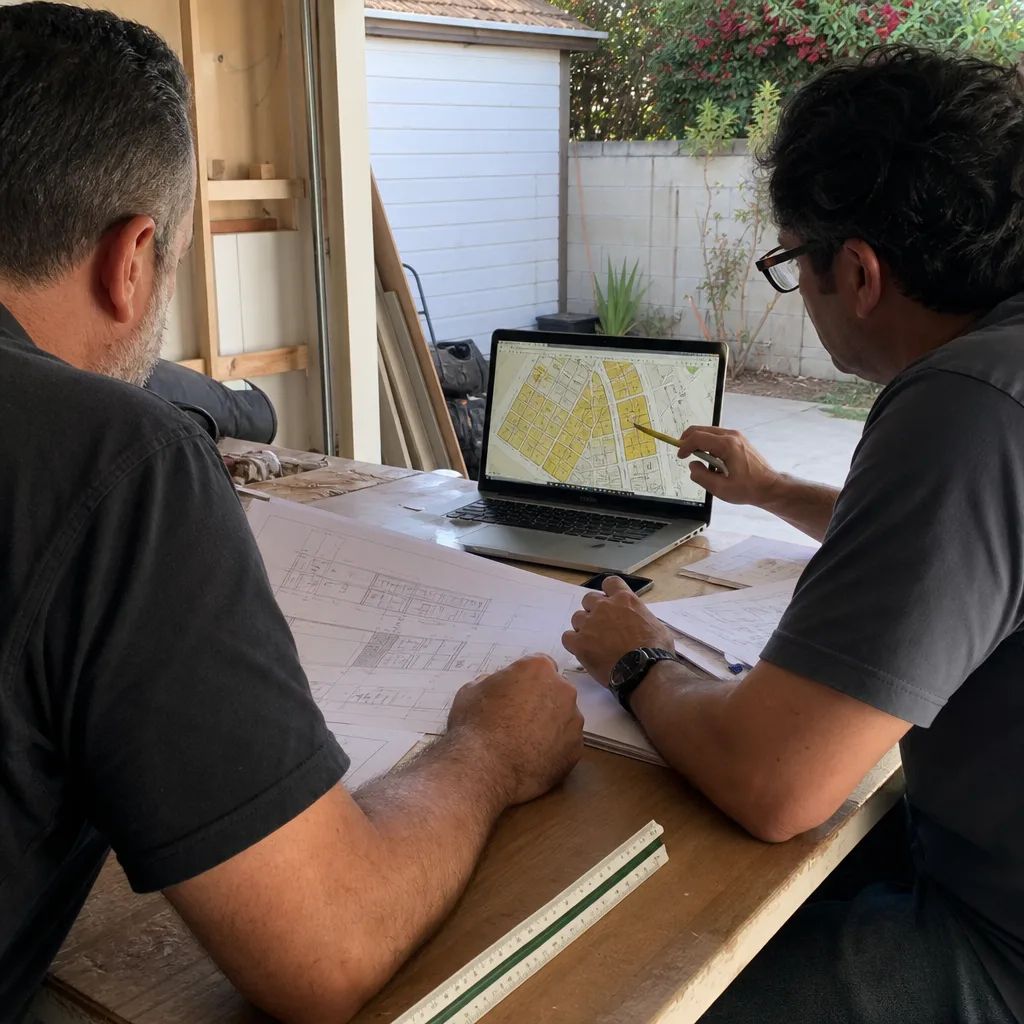
An owner can verify their existing James Hardie spec by checking the stamped zone rating on installed material and comparing it against L.A. County’s ignition-resistant construction checklist, available at ladbs.org. You can also confirm your permit status through the L.A. City DOBS online portal using your case number.
Where DIY goes wrong: interpreting the CBC’s Chapter 7A wildfire-urban interface requirements without a fire protection engineer’s sign-off, which L.A. County requires for certain Westchester parcels. Also, attempting to substitute Hardie products without submitting an approved equal or substitution request to plan check, which voids your permit and triggers a stop-work order. The documentation burden is real, and a rejected resubmission costs six to eight weeks. Call (213) 698-7591 to schedule your free estimate. We also offer a Free Second Opinion on any written estimate or permit set already in hand.
FAQs
How long does a James Hardie ADU permit set take in Westchester?
Initial permit set completion runs four to six weeks from survey and site documentation; L.A. City plan check adds eight to twelve weeks, with one to two correction cycles typical. Call (213) 698-7591 for a timeline based on your parcel’s specific constraints.
Can I reuse my existing ADU permit if I’m only changing the siding to James Hardie?
No. A material change to the exterior wall assembly triggers a revised permit set and new plan check submittal, because the fire-resistance rating and structural loading assumptions change. We handle the revision under our standard design-build contract.
Do you stock James Hardie materials, or do I order through my contractor?
We specify and coordinate James Hardie procurement as part of our single-contract design-build model; the material ships direct from Hardie’s Carson distribution center to your site, with batch numbers documented for warranty registration. We do not stock physical inventory, which eliminates the risk of zone-mismatched product sitting in a warehouse.
How long does James Hardie siding last in Westchester’s climate?
James Hardie warranties fiber-cement product for 30 years; in Westchester’s marine-influenced climate with proper installation, we’ve observed 25-plus years of serviceable performance before cosmetic refresh becomes advisable. The critical variable is installation quality, specifically fastener type, spacing, and sealant continuity at all penetrations.
Ellery ADU Studio Westchester is an independent design-build studio, not affiliated with James Hardie. We specify and coordinate James Hardie, Abodu, Cover, Dvele, and other prefab and modular systems under a single contract at a single written price.
Ready to move forward? Call (213) 698-7591 to schedule your free estimate. Every project receives a written price before any work begins, a documented photo record on every visit, and our 365-Day Done Right Promise in writing.
Written by Nadia Ellery, Owner, Ellery ADU Studio Westchester at Ellery ADU Studio Westchester, serving Westchester and nearby areas.